

I'm a self-employed modeling and simulation engineer. I run my own portfolio to a written policy: strategy sleeves, rebalance bands, trend gates. Except the operations are handled by scripts and AI agents, and my only job is judgment. Every month I'll publish what the machine reported, what it decided, and anything I overrode.
One thing up front: these posts are drafted by my agents from the system's real output, then judged and edited by me. I'm not going to pretend otherwise. The agents are the point.
How I got here, in one paragraph
For years I did special situations. I built something like thirty tools for it: an agent that read SEC filings for five to seven hours straight hunting warrant terms, CVR trackers, net-net screeners, an OTC scanner. They worked. And I quit anyway, not because the strategies were bad, but because they stopped fitting my context: those niches are small and illiquid, and as my portfolio grew, the positions they could absorb became too small to matter. The work stayed the same. The reward, as a fraction of the whole, kept shrinking. What survived the purge was the machinery habit, not the complexity: today the strategy is simple ETF sleeves, and the sophistication all lives in the automation that keeps me honest. The full story is a future post.
The system, in one paragraph
Three sleeves: roughly 60% factor equities (small-cap value with a profitability tilt, plus momentum, spread across US, international developed, and emerging markets, roughly 2:1 value-to-momentum), 35% trend following (managed futures), and a 5% liquidity buffer. Once a month, a script pulls my positions from the broker, maps every holding into its sleeves, checks each sleeve against its rebalance band, checks 3/6/12-month trend gates on total-world equities, and emails me a verdict. Monthly on purpose: rebalancing decisions happen once a month, and checking more often would just be noise. It never places a trade. It tells me the truth. Acting is my job.
This month's report (real output, 2026-08-03)
Verdict: ALL CLEAR. No rebalance needed.
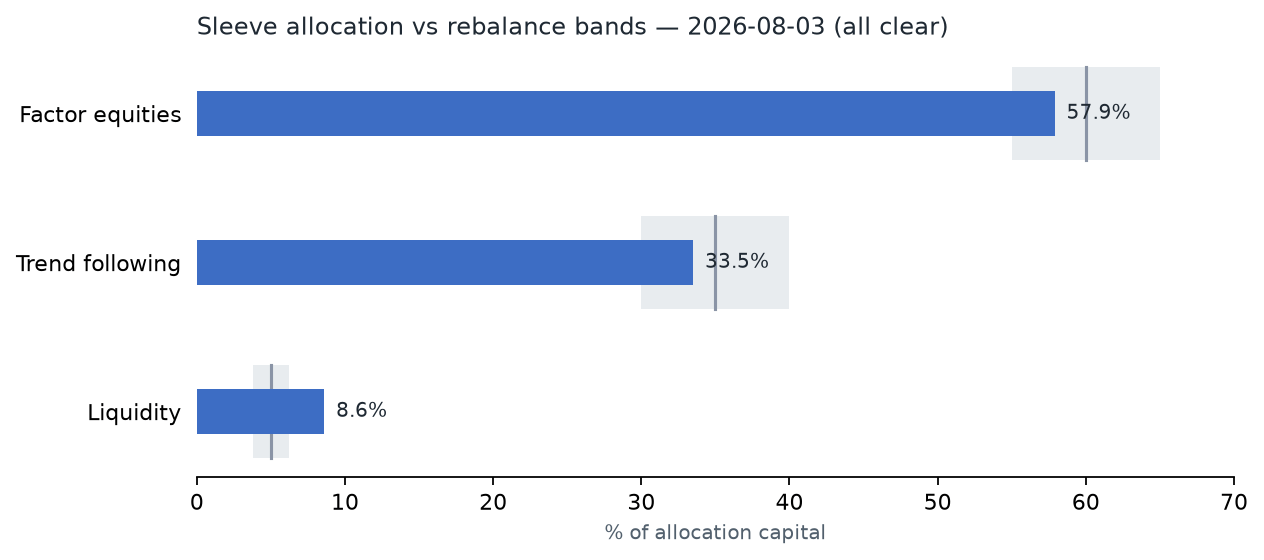
Factor equities: 57.9% actual vs 60.0% target (band 55-65%), drift -2.1pp, OK
Trend following: 33.5% actual vs 35.0% target (band 30-40%), drift -1.5pp, OK
Liquidity: 8.6% actual vs 5.0% target (band 3.8-6.2%), drift +3.6pp, DRIFT
Trend gates: total-world equities above its 3-month, 6-month, and 12-month averages.
The judgment layer
The honest wrinkle this month: the machine flagged the liquidity sleeve at DRIFT, 8.6% against a 5% target, and still called ALL CLEAR. That's by design. Only the two capital sleeves gate action. Factor equities and trend following are the strategy. Liquidity is the residual. As long as both capital sleeves sit inside their bands, there's no rebalance to do. The DRIFT flag on cash is information, not an alarm.
What I overrode this month: nothing. The machine got the same answer I would have. Most months that will be the answer, and that's the entire point. The hardest part of running a simple strategy is leaving it alone, so I built a system where touching the portfolio requires a reason the machine has to produce first.
Next month
Same format, same tables, whatever the machine says. If it says do nothing again, you'll read "do nothing" again. I suspect the long-run value of this diary is watching how rarely anything needs doing.
Drafted by my agents from the system's real output. Judged and edited by me. Not investment advice. I'm describing my own accounts and my own process. Nothing here is a recommendation or an offer of any kind.